Introduction: Planning Ahead Pays Off
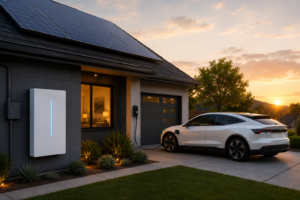
With the rising popularity of electric vehicles (EVs), many homeowners are future-proofing their energy needs by factoring in EV charging when going solar. But how much additional solar do you really need for an EV? And how can you prepare your system today to avoid costly upgrades later?
In this post, we’ll break down:
- How much energy an EV typically uses
- What this means for your solar system size
- Whether batteries or load management tools are worth it
- And how to avoid undersizing your system
Let’s dive in.
How Much Power Does an EV Use?
Electric vehicles consume between 3–4 miles per kilowatt-hour (kWh). So, if you drive 12,000 miles per year, that’s roughly 3,000 to 4,000 kWh per year of additional electricity demand.
| Annual Miles Driven | Estimated EV kWh Needed |
|---|---|
| 8,000 | ~2,000–2,600 kWh |
| 12,000 | ~3,000–4,000 kWh |
| 15,000 | ~3,750–5,000 kWh |
That’s the equivalent of adding a 3–4 kW solar system, depending on your local solar production.
How to Adjust Your Solar Offset for an EV
Your solar offset is the percentage of your home’s electricity usage that’s covered by solar panels. If you plan to buy an EV in the next 1–3 years, it’s smart to increase your offset target today.
For example:
- If your current usage is 12,000 kWh/year, a 100% offset covers that.
- But if you add an EV using 4,000 kWh/year, your new usage becomes 16,000 kWh/year.
- A system sized for just 12,000 kWh will only cover 75% of your future need.
Plan for a higher offset now, so you don’t have to pay for expensive add-on panels or redo your permits later.
Is Battery Storage Necessary for EV Owners?
While not strictly necessary, a battery can help you charge more affordably and keep your EV powered during outages.
Here’s when it’s worth considering:
- If your utility offers time-of-use (TOU) rates, a battery can charge your EV during cheap solar hours.
- If you want to avoid exporting energy at a loss, batteries allow self-consumption rather than sending excess back to the grid.
- If you want emergency backup, pairing a battery with solar lets you drive even when the grid is down.
In deregulated markets like Texas, battery storage + EV = energy independence.
EV Charging and Panel Location Considerations
If you’re planning to install an EV charger:
- Make sure your main panel has enough capacity for the charger (especially 240V units).
- It’s smart to run conduit or wiring during the solar install, even if you don’t have the EV yet.
- Talk to your installer about future-proofing the layout and inverter sizing to avoid system limitations later.
Some homeowners also add a smart load management system (like SPAN or Emporia) to better control EV charging during solar production hours.
EV Compatibility
If you size your system up now to account for a future EV, you may get more value out of:
- One consolidated permit
- One electrical upgrade (if needed)
- One financing package
And you’ll avoid having to reopen interconnection or HOA approvals down the road.
How Eagle Mountain Solar Helps
At Eagle Mountain Solar, we help homeowners think long-term when designing their solar system. If you plan to buy an EV soon, we’ll factor in:
- Your driving habits
- Charging frequency
- Local electric rates
- Utility buyback programs
- And whether batteries make sense for your setup
We can even pre-install an EV hharger so your system is plug-and-play when the time comes.
Final Thoughts: Think Ahead and Save More
EVs and solar go hand in hand—but only if you size your system correctly from the start.
Adding an EV after your solar install without preparing can leave you:
- With a lower solar offset than expected
- Paying more for electricity than planned
- Needing expensive electrical upgrades
Ready to see what a future-ready solar system looks like?
Get a custom quote from Eagle Mountain Solar today and we’ll help you power your home—and your future ride—with confidence.
| |